|
|
Stations, Junctions, etc
Engine Sheds
Other
|
|
London North Western
Railway:
Midland
Railway:
Stratford
Midland Junction Railway
|
|
Rugby Shed
On this page:
Rugby's importance as a junction station combined with being
almost equidistant between Euston and Crewe meant that for nearly one hundred
years Rugby Shed was strategically important, first to the LNWR and then to its
successors, the LMS and the British Railways Board. Hawkin's & Reeve's
state in their book 'LMS Engine Sheds: Volume One - The L&NWR' that
at various times Rugby was an engine changing point for a variety of services,
particularly for the Liverpool and Manchester to London expresses in the 1870s.
It was also an important and complex junction and was therefore an obvious site
to locate an engine shed and servicing facilities. It was realised that
'extensive accommodation' would be required at Rugby 'for the housing
and casual repair of engines' as early as 1847, and in 1850 McConnell
reported 'that additional shelter for engines is much required at Rugby,
there being 22 engines in steam daily and shed room for only eleven.' and
he proposed a shed 'like the one to be erected at Bletchley which may be
removed at little expense'.
This shed was erected the following year and by 1853 two
sheds were in use, one for the Northern Division and the other for the Southern
Division. In 1866 there were one hundred engines at Rugby. Thirty-nine
passenger types (including five banking engines) and fifty-four goods engines
with five 'shunters' and a couple of 'ballast engines'. Water came from Use
River Avon at this time and the supply was very irregular. Ramsbottom suggested
the construction of a 500,000 gallon reservoir and this was approved by the
locomotive committee. The following year an extra siding was ordered to be put
in so that engines did not have to approach and leave the turntable by the same
road, a practice that was 'very dangerous in foggy weather'. Material for this
siding was to be obtained from 'Peterborough Coke Oven Siding'.
Harry Jack of the LNWR Society writes, 'Photographs of this
earlier shed seem to be unknown, but there is a small and rather crude
engraving of Rugby in Measom's Guide to the North Western Railway published in
1859 (see 'lnwrrm2613'). The view is looking west
from the west end of the station. The wooden footbridge crosses the LNWR and
ends in a flight of steps down to a tunnel under the Midland line on the right,
where a Midland Counties Railway (Bury?) engine is standing. In the left
background is the engine shed: the larger and nearer building might be meant to
represent the coaling stage - shown as ‘coke shed’ in this position
on the 1863 plan. There are two round-topped doorways in the centre, one of
which might be the opening seen behind the crew on 'Soult'. The shed itself is
shown as a range of gable-fronts extending to the left and behind the
footbridge abutment. This building is in the position of the radial shed on the
plan'.
Harry Jack further states, 'Most of what is known about the
early history of LNWR sheds can be found in a series of articles in the
Stephenson Locomotive Society Journal of 1957-1960 by the late Leslie W Jones
writing under the pseudonym 'Perseus'. Rugby is dealt with in the August 1957
edition at page 249; apparently the LNWR studied engine sheds on other lines,
including the Chemin de fer du Nord in France, in its search for an ideal
solution to the Rugby locomotive accommodation problem. In the Public Record
Office at Kew there is a plan of Rugby dated 1863 which shows a very strange
engine shed on the south side of the line between the old and new Rugby
stations, just to the west of the long footbridge crossing the main line where
the Midland line comes in from Leicester. Next to the Down line is an oblong
shed with five roads running straight through the building, while a narrow
extension southwards is built on a curve with twenty roads entering radially
from the east, the rails fanning out from sets of points near the footbridge.
The width of this curved extension looks as though it would shelter one engine
on each track; rather like some sheds in France and Germany and presumably this
was the ‘gigantic building with separate compartments for each
locomotive’ described in the Rugby Advertiser of 19th July 1851'.
Hawkin's & Reeve continue, 'in 1875 the establishment
was ordered to be moved 'to the new position on the Stamford line'. The
first shed was completed the following year and by 1886 two large straight
sheds, identical in size and appearance, had been erected at the north side of
the station. Webb had described his design to the Institute of Civil Engineers
a year or so previously and this dates the construction of the second shed.
Both had a north light pattern style of roof with the usual type of large LNWR
coal stage and water tank above. Two 40ft turntables were provided in the yard.
A three road repair shop, an out-station of Crewe, was established on a site to
the north and by 1909 the shed, LNWR No 8, was accurately described as 'very
extensive' and by this lime 'no less than 160 locomotives' were stationed there
including '26 of the newest Precursors’.
The number of men employed totalled nearly 900 and the six
sub-sheds, at Warwick, Coventry, Peterborough, Stamford, Seaton and Market
Harborough, made Rugby one of the largest and most important sheds on the
system. One feature for many years was the large number of locomotives stored
each winter. Particularly in the early 1930s, several dozen locos might be in
store depending on the exact state of the country's economy. At the Grouping a
number of MR locos were taken over from the small Midland shed at the west end
of the station, and the sub-shed at Peterborough was closed. Rugby became the
chief depot of a large district in 1935 receiving the code 2A, and a number of
improvements were carried out by the LMS. Coal and ash plants, by Messrs
Mitchell Engineering Company and Messrs Dempster and Sons Limited respectively,
were erected in 1934 and, between 1938 and 1943, many of the pits were altered
and renewed at a cost of over £3,000. 'No 1' shed, the building nearest
the station, was designated the 'garage' or 'sub-depot' in the 1933 scheme, and
'No 2' shed became the 'concentration' depot. A 55 ft turntable was installed
at the far end of the yard beyond the viaduct carrying the ex-GC tracks over
the West Coast Main lane.
The abandonment of engine changing on many expresses had
left Rugby mainly as a home for freight locos and express types were rarely
allocated until mass withdrawals in the 1960s consigned locomotives like
'Patriots' and 'Jubilees' to lesser duties. However, its position on a critical
junction ensured it remained one of the primary depots of the LMS and it
received a large share of the new Stanier locos when they were built. Some
forty 'Black Fives' were allocated in 1954 with ten '8F' 2-8-0s. The remainder
of the ninety odd locos by this time comprised ten 0--8-0s, nine 2-6-4Ts and a
motley collection of ex MR and LMS 4F 0-6-0s, '3F‘ tanks and '4P' 4-4-0s.
An interesting locomotive was No. 46604, one of the last two surviving Webb
2—4—2Ts. The LMS paid no attention, however, to the roofs at Rugby
and by the end of the Second World War these were becoming decidedly unkempt.
In 1955 'No. 1' shed largely demolished and a new higher roof. in steel with
corrugated sheeting, was provided, the building being drastically shortened at
the same time. The old 'concentration' shed ‘No. 2" was destined for the
same treatment but in the event was left untouched and was finally demolished
in 1960. to make way for a car park. The work* closed in 1959 subsequently
finding a use as a fitting shop for new BTH/BRCW electric locomotives. A repair
shop was built during 1958-9 between the two sheds for the thirteen diesel
shunter* by then stationed at Rugby but advancing electrification finally
‘killed off the depot and it closed, along with Crewe North, on 25th
April, 1965. The shed ended life as 1F, a code it had taken on 9th September
1965, and although the remaining ‘No. 1' building found a use for a while
as a stock store and diesel shunter stabling point, it too has since been
demolished.
back to
top
Rugby's early sheds and locomotives
Select an image below to view the larger version with
accompanying text:
back to
top
The Midland Railway Engine Shed
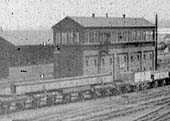
The origin of the Midland Railway's shed at Rugby relates
back to the time when Rugby was the forwarding point for all of the Midland
Railway's London traffic. This was initially in the guise of the Midland
Counties Railway's facilities which were in place by 1844 if not 1840. With the
opening of an alternative route to London via Hitchen, Rugby's importance
steadily declined over the 19th century, not least because the L&NWR's own
needs were restricting the amount of MR traffic that it could handle. The shed
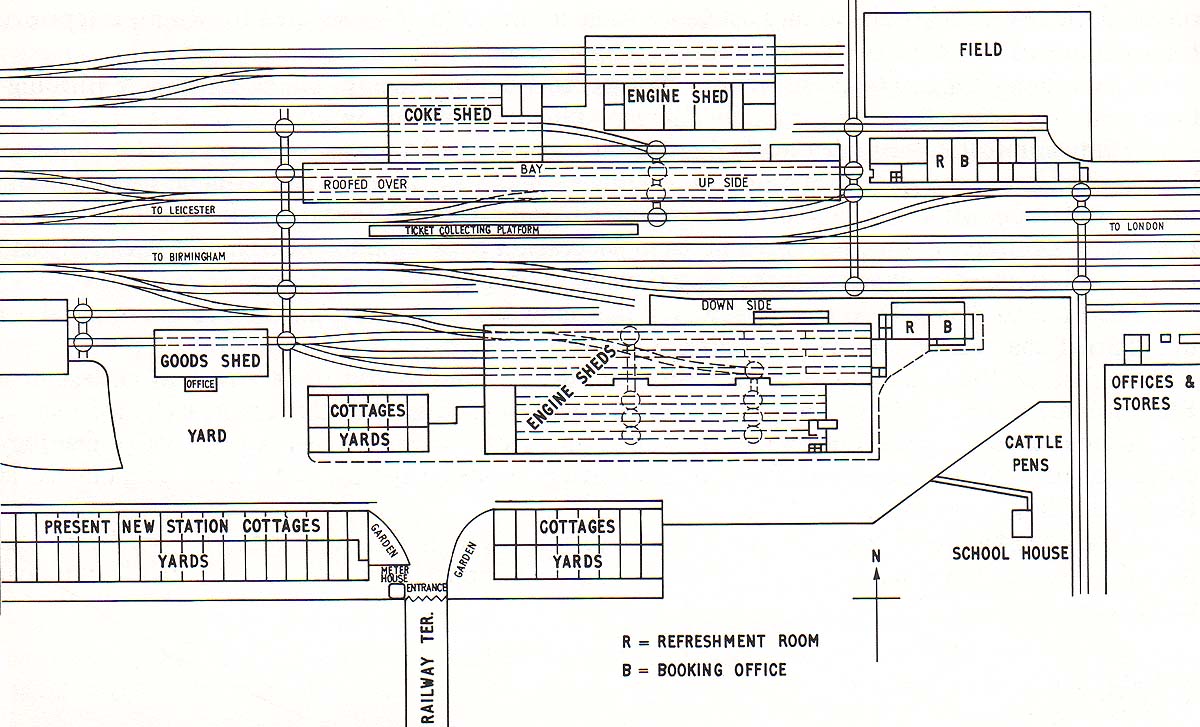
initially was comprised of a two road shed with offices to one side and a three
road Coke Shed with platforms for Leicester bound passengers located along side
(as seen in image 'lnwrrm2468'). The later
configuration of two buildings, a four road shed and a two road shed off-set by
two lines saw the Coke Shed replaced by the new four road shed. This Coke shed
was replaced by a Coaling shed located opposite Rugby No 5 Signal Cabin on the
MR line to Leicester (see image 'lnwrrm3053a').
The four road was located in front of the other shed which whilst of a similar
size only accommodated two roads, the remainder being used as offices, stores,
etc, with water tank above. This section survived the 1936 demolition of the
four road shed and the part of this building housing the two internal lines.
The turntable was accessed by a road passing through the two road shed and
another which ran adjacent to this building. According to Hawkins & Reeve
in their book 'LMS Sheds Volume Two - The Midland Railway, Rugby was for
a long time the home of Kirtley 2-2-2 locomotives which dated from the 1860s.
They lasted into the 1890s with five being recorded together with ten 0-6-0
locomotives. The shed closed in 1903 as part of economy measures with the
locomotives being serviced at Leicester.
back to
top
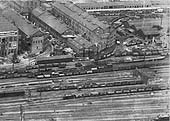
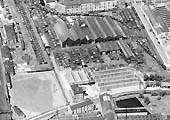
Panoramic views of the 1876 L&NWR Shed
back to
top
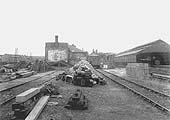
Inside the sheds and workshops
back to
top
Servicing the locomotives - Coaling, Watering and
Turning
Coaling & watering
Turntable
back to
top
Rugby People
back to top
Miscellaneous
Rememberance Sunday Services and Memorials
back to
top
Locomotives from the LNWR Period (up to 1922)
back to
top
Locomotives from the LMS Period (1923 to 1947)
back to
top
Locomotives from the British Railways Period (1948 to circa
1968)
Diesel & Electric Dawn (and Dusk)
back to
top
Ordnance Survey Maps, Diagrams and Drawings
1886 Ordnance Survey Maps
1903 Ordnance Survey Maps
1912 Ordnance Survey Maps
1939 Ordnance Survey Maps
Schematic and Drawings
back to
top
Memories of Rugby Shed – 1958-59
A personal recollection by Ray Sharratt
Rugby Shed was situated on the upside of Rugby Midland
Station. The shed was linked to the station by a footbridge. As it entered the
shed there were a couple of offices on the left, one being the Loco
Superintendents office. One then entered No 1 shed proper.
On the right was the Loco staff mess room and on the wall
were the 'clocking in' clocks. 'Clocking in' was undertaken by all staff except
the footplate crews who signed on in the loco shed foreman's office. The tracks
in the shed led out to one's right and on the left (front of the shed) was the
steep entrance leading from Mill Road and that was adjacent to the shed
foreman's office. The footplate crews reported to the shed foreman, who
designated there duties. They then read all the various notices in the foyer
area that pertained to there duty and then (if taking a loco off the shed)
checked the board outside the office for the loco designated to there duty.
This large black board gave the number of the engine for the particular turn
and its location on No 1 shed. 20 minutes was allowed for signing on and
reading notices and fairly strict times were allowed to walk to various
locations around Rugby Midland station and the goods yards to relieve crews out
on the road. No 1 shed was where the operational locos were stabled, whereas,
No 2 shed was where the fitters and maintenance staff carried out there work.
That said, some maintenance work was undertaken in No 1 shed and certainly most
(but not all) of the loco cleaning was done in No 1 shed. No 1 shed housed the
Locomotive Stores and the office of the Chargehand who looked after the
cleaners, steam raisers and various labourers. In my time at Rugby, Joe Munday
was the Chargehand. On the front of the shed, in Mill Road, was the Loco Lodge.
This was looked after by Joe Munday's wife and was used by a few crews on
lodging turns but in the main by men at the shed who needed some accommodation.
As a sixteen year old passed cleaner, I lived in the lodge for three months in
1959. At the time, there was also a group of fireman from the Liverpool area,
who were on temporary loan to the shed.
Beyond No 2 shed was what I always referred to as the
Erecting shops. This was where heavy repairs and intermediate overalls were
undertaken for the locos in the district covered by Rugby. (2A, 2B, 2C, 2D, and
2E). The work was fairly major as seen by the condition of LNWR Super 'D' 48927
and the term, 'intermediate' meant somewhere around the midway point before the
locomotive returned to Crewe Works for a major overall. During 1959 numerous
locomotives were stored in the sidings that ran between No 2 shed and the
Erecting Shop, stretching almost to the shed engine coaling plant.
The LMS and its successor, British Railways, undertook to
film various aspects of operating steam locomotives and other railway
operations. We have provided below links to some of the films related to shed
operation that we know exist. Films on other aspects of railway operations can
be viewed via our Video and Film Clip
section.
 |
"Wash and Brush Up" 1953
Shows the procedures that a steam
engine goes through as part of its regular maintenance cycle. The locomotive
being featured in the film is a British Railways Standard Class 5MT 4-6-0 No
73020 at 6D Chester (Midland shed. (25 minutes 19 seconds) |
|
LMS On the Shed - Part One of Two
Various shots of an engine
being prepared and serviced ready for its next trip. Includes actions and
responsibilities of crew. (9 minutes 44 seconds) |
|
LMS On the
Shed - Part Two of Two
Various shots of an engine being prepared and
serviced ready for its next trip. Includes actions and responsibilities of
crew. (9 minutes 31 seconds) |
back to
top
|


 Donate
 Facebook
 Search