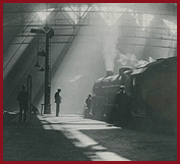
The London Midland Scottish Railway in Warwickshire
Introduction and Background
The birth of railways in Warwickshire is very much aligned
to the birth of railways across the country. After the Stockton to
Darlington Railway, acknowledged as being the first modern railway in the
world, and the Liverpool to Manchester Railway noted as being the first
inter city railway, the next two significant railways were the Grand
Junction Railway, which connected the Liverpool to Manchester
Railway to Birmingham and the London to Birmingham Railway which
connected both the North-West and the West Midlands to the capital.
Initially the formation of railways followed a traditional
pattern. They normally addressed the needs of one or more communities that
would benefit from an alternative to canal or turnpike transport over a given
route. The transportation of goods was seen by the investors as being the prime
generator of revenues although as railways grew it was rapidly recognised that
passenger traffic was also an important driver of growth and prosperity.
However this is not to say that all goods were considered acceptable. In the
early years of the railway the Directors of the L&BR were very much
against their railway carrying coal traffic. Finance was always an issue, not
only in raising the capital estimated to complete the works but also to fund
the almost inevitable shortfall where the initial estimate was found to be
inadequate. Therefore the development of railways both within the county and
the country was associated with companies operating one route.
Within the County of Warwickshire the first railways to be
built were:
The Grand Junction Railway
The London &
Birmingham Railway
The Birmingham & Derby Junction
Railway
The Birmingham & Gloucester Railway
With the expansion and success of railways there was a trend
for the railways to group together to form strategic alliances and to
amalgamate. The above railways amalgamated to form two of the three main
railways to operate within Warwickshire for the next 60 years, the GJR
and the L&BR being part of the London & North Western
Railway and B&DJR and B&GR being part of the
Midland Railway. The third major railway in Warwickshire being the
Great Western Railway. Over the next 80 plus years, these railways grew
their influence by taking over other, smaller lines and by promoting and
building other routes of their own. There were exceptions. the Harborne
Railway, whilst worked by the L&NWR on a revenue sharing basis,
remained independent until 1st January 1923 when it was merged to form part of
the LMS. Another exception was the East & West Junction
Railway (E&WJR) which in 1909 merged with other railway companies from
outside of the county to form the Stratford Upon Avon & Midland Junction
Railway (SMJR) and again with the other listed above on 1st January
1923 to form the LMS. On 1 July 1852, the line from Wolverhampton to Birmingham
via Smethwick was opened by the Birmingham, Wolverhampton and Stour Valley
Railway, which was later absorbed by the LNWR.
Whilst the town of Birmingham (it did not receive its City
status until 1889) was the destination of a number of railway schemes other
initiatives were more strategic such as the Trent Valley Railway which
opened in 1847 to give a more direct route from London to the North West of
England, bypassing the existing route via Birmingham built by the Grand
Junction Railway and the London and Birmingham Railway a decade
earlier. Initially, the Trent Valley Railway was owned by an independent
company, which started building it in 1845. While the line was still being
built, it was absorbed into the newly created L&NWR in August 1846,
and became an important part of the network of routes now known as the West
Coast Main Line. The line was opened officially on 30th November 1847.
Another strategic route through the county but avoiding
Birmingham was the Midland Counties Railway (MCR) which was established
in 1832 to connect Nottingham, Leicester and Derby with Rugby and thence, via
the L&BR, to London. The MCRsystem connected with the
North Midland Railway and the B&DJR in Derby, the three later
becoming the foundation of the Midland Railway when they merged on 10th
May 1844.
From the late 1840s to the 1890s the railway network in the
county primarily increased in response to competition between the three main
protagonists, the L&NWR, the MR and the GWR. Local
businessmen were still instrumental in initiating schemes but whether they were
successful or not often depended on their gaining the support of one of the big
three. In many instances the new lines were not built as point-to-point routes
but were built to join up existing routes to provide new lines. By the turn of
the century the big three railway companies had matured and were now addressing
the shortcomings of the early railways or indeed the problems of capacity
created by their success. Therefore during the late part of the 19th century
and the early part of the 20th century a number of schemes were designed to
increase productivity by building cut-offs, removing bottlenecks or by building
lines to avoid junctions and stations which were stretched to
capacity.
Examples of point-to-point routes include:
Coventry to Leamington (LNWR)
Rugby to Leamington
(LNWR)
Coventry to Nuneaton (LNWR)
Barnt Green to Redditch
(MR)
Nuneaton to Hinckley (LNWR)
Examples of lines built to create new through routes
include:
Aston to Sutton Coldfield (LNWR)
Evesham & Redditch
Railway (MR)
Castle Bromwich to Walsall (MR)
Birmingham & West
Suburban Railway (MR)
Examples of cutoffs, bottlenecks or avoiding lines being
removed or built include:
Lifford Curve (MR)
The Coventry Loop Line between
(MR)
In parallel to the continued expansion and growth of the
railways in the county there was the need to address the parts of the railway
which had become no longer economic or able to fulfill their original purpose.
The earliest example of a railway becoming no longer economically viable was
the B&DJR's Hampton to Whitacre line which occurred less than twelve
months after it first opened on 12th August 1839. This route was, very briefly,
an important part of the Derby to London Route but the high costs imposed by
the L&BR, together with other restrictions on forwarding
B&DJR traffic, made this route vulnerable to third party
competition. The opening on 1st July 1840 of the new and slightly more direct
route to the capital from Derby to Rugby via Leicester by the Midland
Counties Railway was to sound its death bell as a through main line and it
was soon down graded to single line status with a limited passenger and goods
service.
The closure of Curzon Street and Lawley Street passenger
stations in Birmingham was a direct result of the L&NWR's and the
MR's success in generating both goods and passenger traffic. The need to
provide additional resources for both was addressed by the creation of a new
passenger station, initially called Grand Central Station before the
name New Street Station was adopted which is what we know it as today.
Both Curzon Street and Lawley Street were converted to freight only traffic
although Curzon Street did, for a number of years, provide some local and
excursion passenger facilities. The continued operation of these passenger
facilities at Curzon Street does demonstrate that the original portion of New
Street station was already inadequate by the time it opened and it wasn't until
1885 when the station was substantially extended that this issue more fully
addressed.
The London Midland Scottish Railway
The role of the London Midland Scottish Railway
within the County of Warwickshire is not at all similar to the role played by
the Great Western Railway. Whereas the GWR was an entity within
the county from the outset, the LMS only came into being some eighty
plus years after its lines were built in the county. The reason being was that
the precursor railway companies that were to ultimately form the LMS
were themselves amalgams of other smaller companies. The origin of the
LMS therefore begins with the Grand Junction Railway, the London
& Birmingham Railway, the Birmingham & Derby Junction Railway
and the Birmingham & Gloucester Railway.
The LMS only came into existence on 1st January 1923
when the Railways Act 1921, also known as the Grouping Act, was enacted. The
Act was instigated by the government led by (Sir) David Lloyd George (Liberal
Party) and was intended to address the losses being made by many of the
country's 123 railway companies. Much of the country's railway infrastructure
and rolling stock had fallen into a poor state of repair because of the demands
placed on them by the First World War. It was intended to move the railways
away from competition between themselves, and to retain some of the benefits
which the country had derived from a government-controlled railway during and
after the Great War of 1914-1918. In many respects it was the precursor of
nationalisation, a concept considered but rejected but which was to come into
being twenty-five years later after another World War. The Railway Magazine in
its issue of February 1923 dubbed the new companies as 'The Big Four of the New
Railway Era'. These 'Big Four' were: the London, Midland and Scottish
Railway (LMSR); the Great Western Railway (GWR); the London and
North Eastern Railway (LNER); and the Southern Railway (SR).
The companies merged into the LMSR included the
London and North Western Railway, the Midland Railway, several
Scottish railway companies (including the Caledonian Railway), and
numerous other, smaller ventures. The resulting company was an unwieldy
construction, with numerous interests other than railway operations. Besides
being the world's largest transport organisation, it was also the largest
commercial undertaking in the British Empire and after the Post Office, the
United Kingdom's second largest employer. The LMS also claimed to be the
largest joint stock organisation in the world. In 1938, the LMS operated
6,870 miles of railway (excluding its lines in Northern Ireland), but its
profitability was generally disappointing, with a rate of return of only 2.7%.
Along with the other members of the 'Big Four' British railway companies
(GWR, LNER and SR), the LMSR was nationalised on 1st January
1948, becoming part of the state-owned British Railways. The LMS
was the largest of the Big Four railway companies and the only one to operate
in all parts of the United Kingdom: England, Ireland, Scotland and Wales.
The four companies from Warwickshire which were in existence
on 31st December 1922 and which merged with others to form the LMS were:
London and North Western Railway
Midland
Railway
Stratford Midland Junction Railway
Harborne
Railway
Because the London Midland Scottish Railway only came
into being in January 1923, its role in the development of railways within
Warwickshire was to be historically linked with the companies that merged to
form the constituent companies of the LMSR. The Grand Junction
Railway, the London & Birmingham Railway, the Birmingham
& Derby Junction Railway and the Birmingham & Gloucester
Railway were the forefathers of the LMS via their merger with the
London & North Western Railway and the Midland Railway. The
LMS' role within the county was therefore to be more associated with
trying to maintain the railway's competitive edge wherever possible and to
close stations and lines which were no longer viable.
The early history of the LMS was dominated by
infighting between its two largest constituents and previously rivals, the
Midland Railwayand the London & North Western Railway, each
of which believed their company's way was the right, and the only, way of doing
business. Generally, the Midland Railway prevailed, with the adoption of
many Midland Railway practices such as the livery of Crimson Lake for
passenger locomotives and rolling stock. Notable was the continuation of the
Midland Railway's small-engine policy (see Locomotives of the Midland
Railway). The LMS also implemented a novel management structure,
breaking with British railway tradition, and mirroring contemporary US
management practice, appointing a President and Vice-Presidents. On 4th January
1926 Josiah Stamp was appointed First President of the Executive, the
equivalent of a Chief Executive in modern organisational structures. He added
the role of Chairman of the Board of Directors to his portfolio in January
1927, succeeding Sir Guy Granet. The arrival of the new chief mechanical
engineer, William Stanier (later Sir William Stanier), who was brought in from
the Great Western Railway by Josiah Stamp in 1932, heralded a change.
Stanier introduced new ideas rather than continuing the company's internal
conflict. The war-damaged LMS was nationalised in 1948 by the Transport
Act 1947, becoming part of British Railways. It formed the London
Midland Region and part of the Scottish Region. British Railways
transferred the lines in Northern Ireland to the Ulster Transport Authority in
1949. The London Midland & Scottish Railway Company continued to
exist as a legal entity for nearly two years after Nationalisation, being
formally wound up on 23rd December 1949. The lines in Great Britain were
rationalised through closure in the 1950s to 1970s but the main routes have
survived.

|


 Donate
 Facebook
 Search