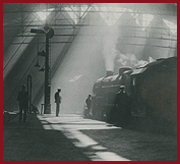
The single line branch from Coventry to Leamington was
opened on 6th December 1844 with the line terminating at Warwick Milverton
station but which was named Leamington. It is thought that the location
of the station which was halfway between Leamington, the fashionable Spa town,
and Warwick, the county town and therefore political centre of the county, was
an attempt to balance costs whilst attempting to provide a service for both
towns. The nine name changes that occurred over the life of the station is a
good indicator that the compromise was never successful. The opening of the
Rugby to Warwick Milverton single line branch in 1851 should, it would be
thought, have offered the citizens of Leamington the opportunity of a station
located more appropriately for their needs. In fact it wasn't until 1854 that
the a small station was provided requiring the first name change at Milverton
from Leamington to Warwick (Milverton). As Preston Hendry and
Powell Hendry state in their book A Historical Survey of Selected LMS
Stations "the attractions of this name paled and the station successively
became Warwick, Warwick (Milverton), Leamington (Milverton), Leamington
Milverton (Warwick) and Milverton for (Warwick). In 1883 a number of
developments on the route caused further physical changes as well as a name
change.
The doubling of the Rugby to Milverton route together with
the opening of the Berkswell to Kenilworth branch was complemented with the
doubling of the Milverton to Kenilworth route resulting in Milverton station
being rebuilt. Its new name of Warwick (Milverton) was introduced in 1884 which
presumably was more acceptable as it retained the name until 1952 when British
Rail decided to change it to Leamington Spa (Milverton) for Warwick.
Milverton had two stations during its years of operational service. The
original station in image 'lnwrwar_stn1374'
clearly shows a single line station with a roof over both the platform and
line. The diagram in A Historical Survey of Selected LMS Stations shows
that a second platform was added. The original station appears to have been a
substantial structure as the plan shows there were 12 rooms including a Station
Masters Office. This building is recorded to have continued in use after the
opening of the second station for Departmental use. Of note is the
juxtaposition of the buildings, being sited on (and opposite) the paved and
hard standing portion of the platforms we see in the photographs. This seems to
indicate that the timber framed and planked portion was built as an extension
to the original station's platforms in 1883.
The second station was built with its booking office at road
level with the access to both platforms being via a covered staircase from
Warwick New Road. The platform structures were built on the timber portion of
the lengthened platforms and were standard LNWR late 19th century timber framed
and clad buildings. The use of timber was both economical, being cheaper and
quicker to erect as they utilised standardised LNWR prefabricated units, as
well as being lighter and requiring less substantial earth works and
engineering works than would otherwise be the case. Preston Hendry and Powell
Hendry make the point that because the routes from Coventry and Rugby and
Daventry overlapped (Coventry to Leamington (Avenue) and Rugby/Daventry to
Milverton) the short stretch of track between Leamington and Milverton saw an
exceptional level of passenger workings for a secondary route. They estimate
that 38 passenger trains travelled on this short section in 1927 without taking
into account the goods traffic that passed on its way to the GWR at Leamington
or further south on LNWR metals avoiding Rugby.
| 1844 |
Leamington |
| 1854 |
Warwick (Milverton) |
| 1856 |
Warwick |
| 1857 |
Warwick (Milverton) |
| 1875 |
Leamington Milverton
(Warwick) |
| 1876 |
Milverton (for Warwick) |
| 1884 |
Warwick (Milverton) |
| 1952 |
Leamington Spa
(Milverton) for Warwick |


 Donate
 Facebook
 Search