|
|
Stations, Junctions, etc
Engine Sheds
Other
|
|
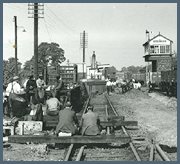
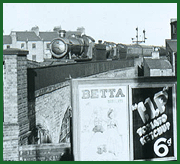
Stratford on Avon Shed
The first engine shed at Stratford-on-Avon was built in 1859
to house the OWWR branch engine. This single road structure was located
opposite the Stratford West Signal Box and deemed inadequate once construction
of the North Warwickshire Railway and Honeybourne Line were proposed. A new
Stratford-on-Avon shed was authorised in March 1906 and the contract awarded to
Messrs. CK Hunt & Son in December 1909 for £3,147. It was opened in
1911 as a sub shed to Tyseley Shed and given the number 5171. The Shed
consisted of an engine shed built to the Churchward standard straight road
design and a combined coaling stage and water tank. The engine shed was 155
foot long by 38 foot wide and accommodated two railroads. The red brick walls
were 18 foot high with large windows along both sides and posts at 10 foot
intervals supporting a series of single 30 foot span trusses on which was an
asbestos slated roof with a glazed clerestory. The roof trusses were
constructed with timber rafters and cast steel ties to reduce the corrosive
effect of the smoke fumes. Integral to the roof were smoke troughs above each
railroad, which lead to ten pairs of square vent shafts. The two gable ends
were also red brick with large double wooden doors for the tracks a both ends
of the engine shed.
The rear doors were provided despite the fact that the
railroads stopped just short of the back gable end. Inspection pits ran almost
the full length of both railroads inside the engine shed and externally pits
were provided adjacent to the entrance. Small red brick office (43 feet by 14
feet) and store (50 feet by 14 feet) buildings abutted the eastern side wall
and were accessed from the engine shed. The engine shed, attached buildings and
yard were all lit by gas lamps. The coal stage was unusual in having a steel
framework with timber walls and the roof was a 22,500 gallon water tank. A
cantilever awning provided some protection from the elements for the unloading
of the coal wagons on the ramp. The water was obtained from the Stratford Canal
which was owned by the Great Western Railway. A small sand furnace was also
provided just outside the engine shed, but post nationalisation a new sand
drier and hopper was provided inside the engine shed. Dry sand was carried in
sand boxes on all locomotives. When required this could be directly applied via
pipes to the rails adjacent to the locomotive’s driving wheels to aid
adhesion. Stratford-upon-Avon's locomotive shed 84E was a sub-shed of
Tyseley shed and was situated on the down side of the main line from which it
had no direct connection. Access to the shed therefore involved several
reversal moves and must have been the bane of the crews' lives. There was no
turntable at Stratford and consequently crews had to use the triangular
junctions at either the former SMJ station or Bearley, although the latter was
the more frequently used.
Known Shed allocations were:
1921
2-4-0T
Metro No 627
2-4-0 Stella Nos 3504, 3527, 3535
0-6-0 Dean Goods No
2306
1934
4-4-0 Duke No 3281
4-4-0 Bulldog Nos 3423,
3426
2-6-2T Nos 5108, 5134, 5139, 5154
1948
0-6-0 Nos
2206, 2297
2-6-2T Nos 3151, 3180
1962 Shed Closed on
September 1962.
Robert Ferris
Much of the information on this and other pages of
Warwickshire Railways is derived from articles or books listed in our 'bibliography'.
Recording Locomotive Sightings 1943 - 1968
The following information is provided courtesy of Shed Bash
UK (http://shedbashuk.blogspot.co.uk/)
A generation of enthusiasts recorded the movements of
locomotives around the railway system. These records of visits to locomotive
depots have been collected and carefully analysed to provide an overall
portrait for the period 1943 to 1968. During that period of steam's final
years, there was a marked change from the pre-grouping types that still found
work at a few depots, to the modern BR designs that worked until the end in
1968. The handling of freight and passenger services was a major undertaking
from town and cities, ports, coal mines and factories. All of it traversed the
labyrinth of lines that criss-crossed the country. There were numerous 'sheds'
spread throughout the length and breadth of the land that provided and serviced
the vast army of steam locomotives (20,000 in 1948). Here is just a taste of
that history.
|

 · LMS
· GWR
· LNER
· Misc ·
Stations ·
What's New
· Video
· Guestbook ·
About
· LMS
· GWR
· LNER
· Misc ·
Stations ·
What's New
· Video
· Guestbook ·
About