|
|
Solihull Station
Robert Ferris has transcribed two articles, one on the tests
undertaken on the bridges located between Olton and Solihull and the other on
the quadrupling of the Birmingham main line. They are available via
Olton to Lapworth - Quadrupling the Birmingham
Main Line.
SOLIHULL STATION late 1945-49 Notes by Colin
Gorton
Visited on way home from school, lunchtimes &
afternoons the following are bits and pieces of memories.
Only locos not Great Western were the Baldwins with USA on
the tender but they soon disappeared. We were not impressed – basically
very ugly and all those exposed steam pipes! Double-framed locos still around.
Bulldogs and Aberdares on goods trains, the latter more frequent. Just once a
‘Duke’ passed through. With its huge dome, running board curved over
the driving wheels and tall chimney it seemed very ancient. Number not spotted
as it was filthy dirty and too far away. 5100 class 2-6-2s hauled all suburban
traffic. Mostly 51xx, a few 41xx.
A variety of 4-6-0 namers on the Paddington services. I
well remember seeing No 100 ‘A'A11 LLOYDS' on Line 1 with an up express. A
really good ‘cop’ that was as were the totally new ‘County’
class and the 70xx series ‘Castles’. We soon got fed-up with the
Kings (only thirty of them) and as soon as we spotted the plate-frame front
bogey approaching, we moaned ‘Oh, it's just a King.’ Strangely I only
ever saw ‘George V’ once. Halls and Saints seemed mostly confined to
secondary through services (presumably going Oxford way?)
The four o'clock express ex. Snow Hill for London often had
a couple of Ex-press Dairies six-wheel milk tankers attached at the rear,
notable for the frantic, staccato rattle of their wheels over rail-joints at
some sixty? m.p.h. (Destination may need correction). Another oddity was the
occasional passing-by of a tube train, all red-painted, hauled by a steam
engine of course and heading from possibly Washwood Heath to London.
Two regular freight trains, time-wise, appeared each day.
The ‘parcels’ stopped at the station for a while around three-thirty.
Hauled by a tender engine, usually a ‘namer’, it comprised a motley
collection of goods vans, passenger brakes and full brakes. The ‘Stewart
& Lloyds’ passed by later. Usually headed by a 28xx working hard with
a load of full 16 ton iron ore wagons from Banbury. If at our other spotting
place near Wadleys Road bridge (halfway to Olton) we often placed pennies on
the line as the S&L moved very slowly – so we could find the coins
afterwards.
We used a different terminology then. There were Lines 1,2,3
and 4. The call ‘peg on Line…’ meant signal lowered, train due.
The crashing of levers in the station's signal-box was another clue!
Solihull's goods-yard was always busy. Shunting carried out
by either 2292 or 2296 from TYS as far as I can recall. The shunter arrived
around 9.30, left late afternoon. Woe betide the shunter if it drew up with
wagons alongside Line 1 at the station blocking our view when an express was
due as we usually leaned against the railings beyond the station entrance on
our bikes. Rover car bodies were delivered from the Pressed Steel Co., Cowley
to Soli-hull on flat trucks covered overall with bright orangey-red tarpaulins,
the bodies were off-loaded onto lorries for the short trip up Lode Lane to the
Car Works. The background sound of shunting was perfectly imitated by Reginald
Gardiner later on his ‘Trains’ record.
We noticed little difference in 1948 except that we were
appalled at the insipid-blue livery on one King and basically we ignored the
occasional LMS stuff that snuffled through on goods trains. Fancy having
painted numbers! By this time though we ‘spotted’ on the station
(island platforms 3/4) as long as the ‘miserable’ porter wasn't on
duty - platform-tickets, no way. The reason was the '12:30 turn round’. If
we cycled like mad from School we made it just in time and if ‘our
driver’ was on we always got a footplate ride. The other ones always said
NO!
The engine would uncouple to run round the train and then
shunt it from Platform Three round to Four ready for departure. Driver and
fireman would then often pop into the porter's room leaving us three in charge
of the engine. Health & Safety – what's that! The best bit was
charging light-engine through the station on Line 4 along to the crossover. We
always got to pull the whistle as we jumped down at one o'clock. Happy days.
One day we were told ‘You must be here tomorrow as we're bringing a
special engine.’ Slightly disappointed when it seemed only a fifty-oner,
our minds soon changed as it drew to a halt. Ex works, painted in Great Western
green and with British Railways emblazoned on the tank-side in gold lettering,
we were very impressed. The date I cannot recall.
Colin Gorton
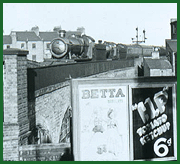
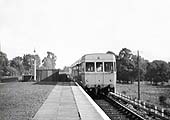
The original Solihull Station prior to the quadrupling of
the main line
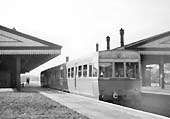
Solihull Station rebuilt after quadrupling
Ordnance Survey maps and Signalling Diagram showing the
original and rebuilt stations
Locomotives and trains seen at or near Solihull
station
Diesel Dawn
|


 Donate
 Facebook
 Search