|
|
Stations, Junctions, etc
Engine Sheds
Other
|
|
London North Western
Railway:
Midland
Railway:
Stratford
Midland Junction Railway
|
|
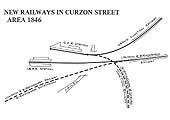
Curzon Street Engine House
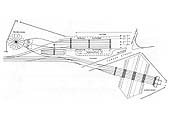
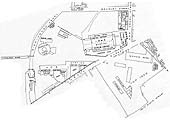
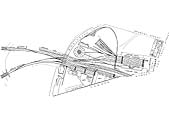
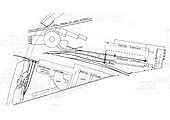
The Engine House was opened on 12th November 1837 when goods
trains started to run between Birmingham and Rugby. Its location, just a few
hundred feet in front of the passenger station, reflected the initial practice
of basing railway operations on those adopted for horse-drawn road vehicles and
canals. This manifested itself in many ways, from early railway carriages being
built with each compartment looking as if it was a stage coach to the
accommodation of steam locomotives being based on the practice of stabling
horses at Inns etc. In this respect it meant that locomotives were to be
stabled next to the station. This close proximity, together with the unexpected
volume of traffic generated necessitating the construction of New Street
station, meant that the Engine House would be closed within twelve years
despite being extended twice in this short space of time. When the Engine House
closed in 1859 the men from Curzon Street were transferred to Monument Lane
shed which had opened in November 1858.
Richard Foster in the first volume of his excellent series
on New Street Station 'Birmingham New Street - Background and Beginnings the
years up to 1860' quotes Cheffin's London & Birmingham Railway in
describing the facilities when the Engine House was first opened. 'The
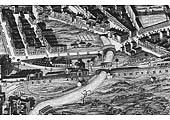
Locomotive Engine-house is a building with sixteen sides, capable of holding
sixteen engines and tenders or thirty-two engines alone: these stand with their
ends towards the sides of the building, one against each, on sixteen ways, all
meeting on a turn-plate in the centre, by which the engines are sent to their
respective lines of rails, which run from the Engine-house to the Station.
Under each engine is a pit, three feet deep, which enables the engine-men to
get underneath the engine to examine, clean, or repair it. In front of the
Engine-house are store rooms, offices, and workshops, over which is a tank,
holding one hundred and seventy tons of water, with provision for a
steam-engine to work a pump from a well below, in case the supply from the
Water Works Company should fail. The engine-house is built on land about twenty
feet lower than the present surface, under which are store rooms for coke, and
a communication to a large vault under ground, which opens to the
canal'.
Richard also provides information from Francis Wishaw's
description of the station in 1842 in which he notes that the building was
erected some 88 feet from the canal, 418 feet away from the last row of
turntables used to access the lines running into the station's train shed and
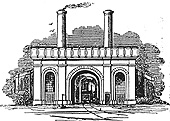
was 124 feet in diameter. Towards the passenger station a building projects out
which is 60 feet in depth and 63 feet in front: in the middle of this is the
entrance for the locomotives. The turntable in the centre of the shed is 15
feet in diameter, from which 16 lines radiate out with two lines continuing
outwards. One line is for outgoing engines and the other is for incoming
engines. The centre portion of the building had no roof whilst the sides
covering the radiating lines was covered by a light iron roof. Wishaw writes
'On each side of the outgoing line is a circular shaft into an arched way
below, for the purpose of raising coke therefrom. The passage communicates with
the coke-vault, which being nearby on a level with the canal, the coke is
readily transferred to it from the barges. Along the middle of the passage a
single line of way is laid down with a gauge of 18 inches: on this the coke is
moved from the cellar, by means of small trucks, to underneath the eyes or
shafts above mentioned. The vault being at right angles to the passage, a small
turntable is placed at the meeting of the two lines in the middle of the vault;
the second line runs down to the canal. The coke vault is arched, is about 300
feet long, 30 wide, and 20 feet high, and is calculated to hold about 1400 tons
of coke. The communication between the locomotives shed and the vault beneath
is by means of a flight of 27 steps, each rising 8¼ inches'.
Richard noted the conflicting interests of the goods station
as it expanded rapidly after passenger services had moved to New Street station
and the needs of the locomotive department. By 1859, the position was becoming
very difficult; there was just not enough room to handle the traffic now on
offer. The Loco- motive Department was having similar problems, with far too
many engines for the servicing facilities available. As it stood, the existing
Curzon Street site was full, and the size and position of the engine house
effectively prevented any improvement or enlargement of the facilities, either
for locomotives or for goods traffic. Richard writes 'As far as the goods
station was concerned, there was clearly no alternative but to take the engine
house down. On 25th February 1859, Mr Baker, the company's engineer,
recommended that the round-house at Curzon Street should be removed to make way
for the enlargement of the goods station. This was accepted, and Mr McConnell,
the Southern Division Locomotive Superintendent, was required to remove his
engines and men from the premises by the end of March - not much notice!
Despite the formation of the LNWR in 1846, many of the day-to-day operations of
the former GJR (now the LNWR Northern Division) and the L&BR (now the
Southern Division) continued to be distinctly separate and largely independent.
New Street Station and Curzon Street Goods Station marked the boundaries
between the two. Thus, the engine shed at Curzon Street was for the Southern
Division, and the Northern Division had its own sheds at Vauxhall (the old GJR
locomotive depot) and Monument Lane. The decision to remove the shed at Curzon
Street therefore left the Southern Division without a locomotive depot in
Birmingham, and so some alternative arrangements were required.
Richard notes that the Locomotive Committee visited
Birmingham to review arrangements, and on 23rd March recommended that 'The
Establishment of the Northern Division be wholly removed to Monument Lane and
that the Works Committee report at what cost the new Offices there built, can
be converted into cottages for the work people. That the establishment of the
Southern Division be wholly removed to Vauxhall, and that the Works Committee
make the arrangement proposed for placing a large engine turntable with a water
crane in the fork of the two main lines out of Curzon Street and that Mr
McConnell remove the large water tank at Curzon Street to the cokeing (sic)
platform at Vauxhall, bringing in if possible the cast iron pillars reported to
be lying at Huddersfield. That the locomotive establishment be immediately
removed from Vauxhall to Monument Lane and from Curzon Street to Vauxhall'.
Richard notes that under this arrangement, the Northern Division would have one
shed at Monument Lane and the Southern Division a shed at Vauxhall. As the
round-house at Curzon Street was so clearly in the way of any improvements, the
work of moving to Vauxhall, and of demolishing the shed, was quickly put in
hand. On 26th May 1859, it was resolved 'that the wooden sheds adjacent to
the old engine house at Curzon Street be transferred to the Locomotive
Department, Southern Division, at a cost of £25'. Mr McConnell later
reported that he intended to 'erect them at Wolverton to serve as a
temporary boiler house'. On 24th June 1859, Mr. Baker was able to report
that 'he had succeeded in inducing the contractor to allow £600 for
the roof of the old engine shed at Birmingham, and that he had sold the
remainder of the building for £800. Finally, in March 1860, the engineer
was asked to ascertain if the empty water tank at Curzon Street would suit the
needs of Bolton shed, where the existing tank was too small'.
The preceding decade had been a time of severe economy and
make-do-and-mend on the LNW. At Vauxhall shed in 1850, a scheme for the
temporary covering of‘ engines for the forthcoming winter had been
prepared, but even this was put off, and it was not until 8th December 1854
that authority was given to build covered accommodation. Even then, the
solution adopted was cheap in the extreme, £364, which covered the cost
of dismantling an old wooden engine shed at Camden and re-erecting it at
Birmingham. The work was completed in November 1858, not long before the
Northern Division, which had waited so long for the accommodation, were told to
move elsewhere. With these developments, as Richard states in his book, 'the
stage was now set for the transformation of Curzon Street from station and
engine houseinto a fully-fledged goods station'.
If you are interested in knowing more about Curzon Street
Shed you can do no better than to read Richard Foster's series of books on
Birmingham New Street - The Story of a Great Station including Curzon
Street published by Wild Swan Publications Ltd of Didcot. I would like to
take this opportunity of crediting Richard Foster as being the source for much
of the rich information provided in the captions to the photographs.
The LMS and its successor, British Railways, undertook to
film various aspects of operating steam locomotives and other railway
operations. We have provided below links to some of the films related to shed
operation that we know exist. Films on other aspects of railway operations can
be viewed via our Video and Film Clip
section.
 |
"Wash and Brush Up" 1953
Shows the procedures that a steam
engine goes through as part of its regular maintenance cycle. The locomotive
being featured in the film is a British Railways Standard Class 5MT 4-6-0 No
73020 at 6D Chester (Midland shed. (25 minutes 19 seconds) |
|
LMS On the Shed - Part One of Two
Various shots of an engine
being prepared and serviced ready for its next trip. Includes actions and
responsibilities of crew. (9 minutes 44 seconds) |
|
LMS On the
Shed - Part Two of Two
Various shots of an engine being prepared and
serviced ready for its next trip. Includes actions and responsibilities of
crew. (9 minutes 31 seconds) |
|


 Donate
 Facebook
 Search