|
|
 |
|
|
London North Western
Railway:
Midland
Railway:
Stratford
Midland Junction Railway
|
|
LMS Route: Birmingham New Street to Lichfield
Gravelly Hill Station: lnwrgh58b
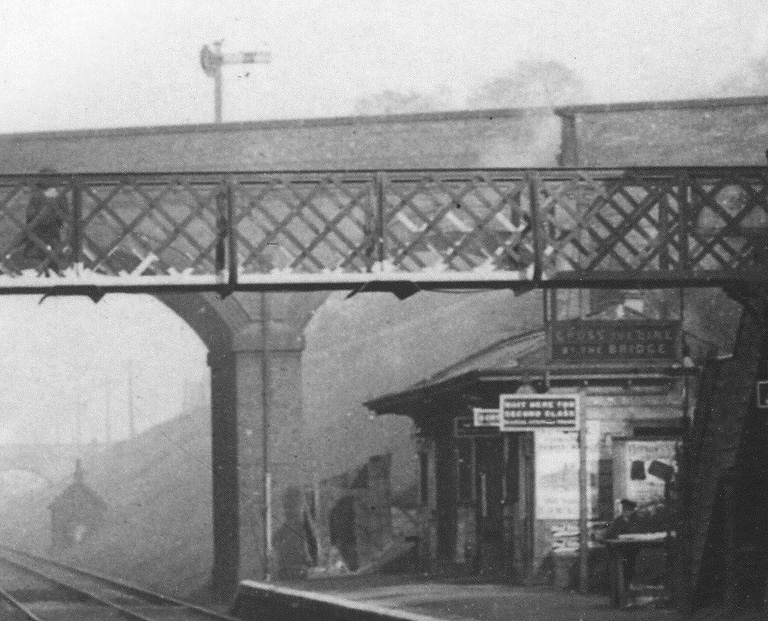 |
Close up of image 'lnwrgh58' showing the passenger waiting
rooms and other facilities located on the station's Birmingham platform. In
front of the single storey structure seen more clearly in image
'lnwrgh1487' a sign which reads 'Wait Here for
Second Class on local stopping trains'. The other signs appear to indicate
individual toilet and waiting room facilities although whether they were for
either Second Class passengers only or for general use is not known. As will be
known to any passenger familiar with travelling by train up to the 1960s,
travel was either by First or Third Class facilities as Second Class travel was
abandoned by most railway companies in the late 19th Century. Does this
indicate the photo was taken prior to this date or that the signs remained for
some time afterwards? In response to my queries as to when the LNWR ceased
offering 2nd class travel I received this very expansive explanation from Steve
Weston, the Editor of LNWR Society's Journal and Newsletter.
According to Reed ‘The London & North Western
Railway’ ISBN 0 906899 66 4, there had been a significant rise
in 3rd class at the expense of 2nd (1st class being relatively stable) due to
trends in traffic volumes, journey lengths and fares. Third class fares,
although low, were made up of many short journeys, and there had been a rapid
increase in these in the 1860s. The Midland had admitted 3rd class to all
trains on 1 Jan 1872 and abolished 2nd class in 1875. From 1872 3rd class were
allowed on most trains on the LNWR plus offered through bookings and tourist
fares on longer journeys. As a result, 3rd class revenue jumped from 32% of
earnings in 1871 to 42% in 1873 and 46% in 1873 whilst 2nd class fell from 28%
to 18% to 16%. None of the other major lines had followed the Midland but the
Midland had also lowered its 1st class fares to 2nd class levels. Thus everyone
else had to lower their 2nd class fares thus ‘pinching’ the second
class differential.
Richard Moon the LNWR chairman was against the abolishment
of 2nd class; it seems his views over-ruled economic reasons! Second class was
abolished on the Anglo-Scottish services in May 1893 as the Caledonian had
already done so. This coincided with the introduction of the new West Coast
Stock. Lord Stalbridge, chairman after Moon persisted in supporting second
class although new stock was being built so that 2nd class could be converted
easily. Second class was abolished on all but a few suburban services after
Stalbridge retired in February 1911. The main abandonment of 2nd class was 31
Dec 1911. The National Coal strike started in May 1912 and this saw the final
abandonment of 2nd class together with restricted services. All 2nd class was
suspended during the coal strike and despite parliamentary questions they were
not restored after the end of the coal strike. Steve Weston concludes 'Long
winded I'm afraid but Reed covers it quite well and goes into the reasons in
some detail and I found it quite interesting. Reed's book is a very thorough
history and at times is a bit hard going. However it's well worth buying and if
you need to know anything about the LNWR it's usually there'.
 back back
|
|
|


 Donate
 Facebook
 Search