|
|
London North Western
Railway:
Midland
Railway:
Stratford
Midland Junction Railway
|
|
LMS Route: Birmingham New Street to Nuneaton
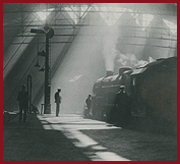
Nuneaton Abbey Street Station: mrna49a
Close up of image 'mrna49' showing the Midland Railway
signal gantry to be carrying lower quadrant semaphores. The position of the
arms' spectacle plates confirms that they are lower quadrant (they will point
down to the 7 o'clock position when in the off or 'all clear' position). Each
signal had two spectacle plates located at the hinged end of the arm, one red
and one green. When the arm was horizontal it was in the danger position and
the red spectacle plate was therefore positioned to be in line with the arm and
to be lit by an oil lamp fixed behind the plate. When the signal was placed in
the off position, the arm would point down and its green spectacle plate (which
was positioned below the red plate) would be raised to be in front of the oil
lamp. These lamps were in the care of the signalman who would be responsible
for them to be charged with oil and for their wicks to be trimmed, a task
carried out in day light.
 back back
|


 Donate
 Facebook
 Search