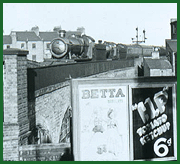
Bordesley station was opened in 1855 on the GWR Birmingham
to Oxford line between Snow Hill and Acocks Green as Small Heath and Tyseley
were not opened until some time later. Bordesley station was unusual because it
was built entirely on a viaduct. Initially the station was a conventional two
platform station with a large goods shed and sidings. As part of the extensive
upgrade to the route in to Birmingham, which saw the construction of Moor
Street to handle local passenger services, Bordesley station was upgraded to a
two-island platform facility, with one island handling local passenger services
to and from Moor Street and the other handling traffic to and from Snow Hill.
The station provided significant cattle facilities adjacent to and on Duddeston
Viaduct, the long abandoned aborted link to the London & Birmingham
Railway's Curzon Street station. Between Small Heath and Bordesley was a
significant goods yard facility. Whilst in the 1930s eleven or twelve staff
were employed at the station the loss of traffic in the 1960s saw the station
downgraded to provide a minimal level of passenger services mainly concentrated
on providing football fans access to Birmingham City's St Andrews football
ground.
| A Birmingham reader, Mr T
Hinckley, some time ago forwarded particulars of locomotives seen during two
hours at Bordesley Station. While we do not propose to print these in full, the
following extract may be of interest: |
|
Bordesley is the first station
on the main line south of Snow Hill, although the Moor Street terminus, used
for suburban traffic, is between the two; consequently trains going north from
Bordesley may be either main line trains to Snow Hill and the North, or locals
terminating at Moor Street; also trains on the main line pass outside Moor
Street Station, and can be seen from the platforms.
|
|
The Moor Street locals are
worked by auto-trains, 0-4-2T Nos 1425 and 1155, and 0-6-0ST No 2124 being on
these in July last. |
|
The Snow Hill locals are worked
mainly by ‘Camel’ tanks, e.g., No 3602, 3603, 3604, 3608, and 2-6-2T,
e.g., 3913, 3918, 3920, although No 627 (2-4-0T) was also observed. |
|
The main line goods traffic is
worked by various types, of which the numbers given were noted; 2-8-0 No 3000
and ROD 1739; 2-6-0 No 2606 (NA); 0-6-0 No 1092; 0-6-0ST No 1136; 0-6-0 No
2337; etc. |
|
The 2.55 p.m. (ex Snow Hill) up
express was hauled by No 4043 ‘Prince Henry’, while the 4-4-0 types
were also in evidence, e.g., No 4159 ‘Anemone’, No 3305
‘Tintagel’ (HFD) or (CDF), No 3264 ‘Trevethick’. |
|
There is a good deal of light
engine working to and from Tyseley shed, and one of the most interesting
engines noted was No 322, an old Beyer Peacock saddle tank. |
|
Thus it will be seen that GWR
enthusiasts visiting Birmingham might do worse than spend an hour at Bordesley,
especially with a camera as a companion. |
Simon Richards wrote, 'I've read your pages on Bordesley
station with interest. The first time I remember using the station was in 1968
as an 8 year old. It was just before the current layout. This what I believe -
The entrance wasn't the current one it was to left (if facing towards Small
Heath}. You went in and turned right to get to the stairs. In front of you was
a ticket office - which even then had been closed. Soon after the entrance was
bricked up. At the bottom of the stairs you can see where the way to the ticket
office was.'


 Donate
 Facebook
 Search