|
|
Olton
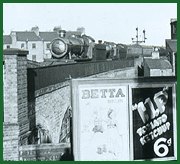
Olton station opened in 1869 on the Birmingham and Oxford
Junction Railway which by that time had been absorbed into the Great Western
Railway. It was never seen as a station of significant importance and never
warranted a goods yard. Its principle function was as a suburban passenger
station for Birmingham commuters, which explained why the booking office was
located on the down platform. Olton station had for some sixty-three years a
two platform configuration with basic facilities, but taking advantage of the
Development (Loan Guarantees and Grants) Act of 1929, the Great Western Railway
continued to quadruple the Birmingham Main Line as far as Lapworth, rebuilding
five stations including Olton with two wide island platforms.
Olton had two signal boxes, the first of which only had 10
levers. It was built by McKenzie and Holland and located at the Leamington end
of the up platform. This signal box was replaced in June 1913, when the
quadrupled track, which had been installed as loops as far as Tyseley in 1907,
was extended to Small Heath North and remodelled to form main and relief
running lines. The new signal box, located at the northern end of the station
to oversee the junction, was a classic Great Western Railway design (type 7D),
equipped with 31 levers. In December 1931, an interlocked ground frame was
provided to control the switches associated with a siding that was connected to
the up line at the southern end of the station. When the station was remodelled
in 1933 and the quadrupled line was extended to Lapworth, the Signal Box was
closed with control passing to the adjacent signal boxes.
Two transcribed articles, one on the tests undertaken on the
bridges located between Olton and Solihull and the other on the quadrupling of
the Birmingham main line, are available via Olton to Lapworth - Quadrupling the Birmingham
Main Line.
Robert Ferris
Select an image below to view the larger version with
accompanying text:
Views of the original station
Views of the rebuilt station
Olton Sports Ground
To facilitate the construction of the Birmingham &
Oxford Junction Railway land was purchased at Olton in 1854. One of these
parcels of land was retained and from 1923 was used as a Sports Ground. The
sports ground proved to be very popular and in 1926 a sports pavilion was
provided. This building survived the quadrupling of the railway line in 1933,
but use of the ground appears to have gradually waned. In 1938 the Great
Western Railway sold the sports ground and the pavilion was recorded as being
taken down in 1939. The land was developed as housing.
Our thanks go to Keith Staples for sharing his
research.
Locomotives and trains seen at Olton Station
Diesel Dawn
Miscellaneous
Maps
|


 Donate
 Facebook
 Search