|
|
GWR Route: Banbury to Wolverhampton
Leamington Spa - GWR Locomotives: gwrls897
 |
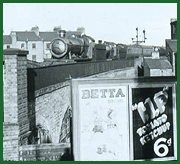
An unidenitified GWR 4-6-0 King class locomotive at the head of
the 9.05 Birkenhead to Paddington express train runs into the up platform. The
Kings were a regular performers on the route to Birkenhead from the 1930s
through to the end of steam on GWR lines in the early 1960s. The King class was
the final and most powerful development of the GWR’s 4 cylinder designs.
GWR CME (Chief Mechanical Engineer) Charles Collett’s Castles were
arguably the GWR’s finest passenger engine design, and on a tractive
effort basis, had proved themselves more powerful than LNER’s Flying
Scotsman. Nevertheless, the advent of the Southern Railway’s King Lord
Nelson class as the new leader in British express steam tractive effort
(33,500lbs) pushed the GWR’s publicity office to push for one greater
engine class, with a nominal tractive effort of 40,000lbs. The apparent need
for such a class existed on the heavily graded routes in South Devon, en route
to Plymouth. However the ‘hammer blow’ of the weight of each axle
plus the effect of reciprocating parts was expected to be in the region of
22½ tons, 3 tons in excess of the 19½ ton static design limit of
most GWR bridges. Luckily, across the huge and unwieldy GWR organisation, the
civil engineering division had been independently raising the bridge loadings
to 22 tons for the previous 22 years, and a concession of 22½ tons was
made for 4-cylinder engines. For 22½ ton axle loading, routes from
London to Plymouth and Cardiff, on a handful of bridges would need
strengthening. These routes would become the ‘double red’ routes of
the GWR, and the Kings would rarely stray from them.
Collett opted for smaller wheels on the King than his Castles,
after casting aside the conventional wisdom that large wheel diameter was
needed for the greatest speed. He had observed an express train being
overhauled by a mineral train hauled by a close-coupled GWR 4-8-0 with small
wheels. When compared with the Castle class, the slightly smaller wheels
adopted for the King Class allowed more space above them for a fatter boiler to
be built, as little extra engine height was available for expansion.
Nevertheless, such a reduction in wheel size was not without its corresponding
problems. A long standing Swindon design constraint imposed by former CME
George Jackson Churchward, was that the pistons would be level and not slanted.
This meant the centre height of the pistons would be the same as the driving
wheel axles. The smaller wheels thereby lowered the height of the pistons. At
the same time, to achieve the 40,000lb tractive effort, the pistons were
enlarged to 16¼” bore and 28” stroke. The outer pair of
pistons, acting on the centre wheels, needed to hang either side of the rear
wheels of the front bogie. The hidden inner pair of pistons, acting on the
front set of driving wheels, hung low between the front wheels of the bogie.
Both factors meant a traditional springing arrangement for the bogie was
impossible. A compromise design with the front wheels sprung on the outside and
the back wheels of the bogie sprung on the inside, produced the distinctive and
decidedly odd-looking long front bogie of the Kings.
Like on the Stars and Castles before them, the Walschaerts valve
gear was concealed between the frames, and driven off the front set of driving
wheels. The two inner valves, directly above the inner pistons, were driven
directly from these sets of valve gear. The outer valves, directly above the
outer pistons, took a reflected drive from the inner valve gear via a pair of
rocker arms emerging from the frames above the front bogie. Like the Stars and
Castles, no external valve gear was visible, but this aesthetically pleasing
arrangement made for a maintenance nightmare, with over 120 oiling points, many
hard to reach, before the engine could take to the road. Draughting
arrangements included a 'jumper' blastpipe ring (the blastpipe is inside the
smokebox and directly under the chimney - it directs the steam exhaust straight
up into the chimney and in doing so creates a strong sucking action on the fire
in the firebox, drawing the hot gases through the tubes of the boiler.) A
jumper ring was designed to allow the blastpipe to lift and expand under heavy
working. Courtesy of '6023 King
Edward II Project'.
 back back
|


 Donate
 Facebook
 Search