Guest Book: Page 24
Page 25 : Page 24
: Page 23
The photos and captions brought back so
many memories, especially the ones of Small Heath and Sparkbrook. Thank you for
a very enjoyable link to yesteryear. BRILLIANT!
P Battey
Hi Mike - Had a look at your pictures of
the gun barrels being moved on the Foleshill Railway. The shot on the bridge
was I believe over Widdrington Road - the brick abutments of which are still
there. Also, when I was an apprentice at Coventry Gauge and Tool Co., one of
the old boys who taught us in the apprentice school was, in his turn, an
apprentice in Coventry Ordnance Works and reckoned that because of the very
tight curves, especially under Foleshill Road, the barrels had to be slewed
across the trolley wagons to prevent them hitting the retaining walls. He was a
little chap, even then, and was actually sent down the 15 inch gun barrels with
a brush, to sweep out the swarf!
Dave Walker
Well done - a very useful resource.
J E S Bradshaw
Great site for the railway fan, love
it!
Tony Kosarew
I have just obtained a copy of Tony Higgs
excellent book on Monument Lane. I have a particular interest in this shed
because my Granddad Joe Simmons (mentioned in the list of drivers at the shed
in 1951) and my uncle George Simmons were both footplate men there. My granddad
started work there in 1906 as a cleaner and retired in the early 1950's because
of ill health. My uncle started in 1934 as a cleaner and became a registered
fireman before going off to war in 1939.
He was seriously wounded at
Dunkirk and never returned to the railway. In the late 1960s my uncle recorded
his life on the railway but unfortunately he was never able to get it
published. It's a very detailed account of the times and makes compelling
reading but because of its length and lack of photographs the publishers never
considered it commercially viable. A great pity. Ironically he died last year
at the age of 89, I'm sure he would have liked to have contributed to Tony's
book.
Bruce Morgans
An invaluable website for the train
enthusiast. Congratulations!
Kevin Parrish
It is good to see these interesting
photographs. Tamworth is no longer the fascinating place it once was!
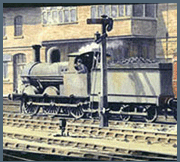
Firstly, No. 1676 'The Nile' (image 'lnwr_tam1261' is not a ‘Newton’
but an ‘Improved Precedent’ or ‘Big Jumbo’. The original
‘Newtons’ and ‘Precedents’ were replaced by ‘Improved
Precedents’ between 1889 and 1901, No. 1676 being replaced in 5.1891.
Secondly, the date ‘circa 1919-1923’ must be, at best, a wild guess,
as there can be no evidence for it whatsoever, and several features of the
engine and tender enable the date to be determined more precisely at an earlier
period. Firstly, so far as I can see from the computer screen, the engine has
no centre lamp socket on the bufferbeam. This fitting was required from 1st
February 1903, when the LNWR, along with most other companies, adopted the
Railway Clearing House head lamp codes. So the date must be before that.
Secondly, another early feature is the stanchion by the tool box on the front
of the tender. This supported the communication cord on its way to the second
whistle on the cab roof. This system was done away with over time in the early
twentieth century but had certainly gone by the post-war period. Thirdly, coal
rails were first fitted to tenders in May 1895, so the date must be after that.
In fact, The Nile was scrapped in 9.1906.
Incidentally, some writers on
LNWR locomotive history have used lurid language about the scrapping of the
Webb three-cylinder compounds – ‘the slaughter of the Webb
compounds’ and even ‘the slaughter of the innocents’ – but
in fact all the Problems and Jumbos that were scrapped before the Great War
were newer engines than the compounds. Finally, two more points: in view of the
head lamp code, the train is likely to be an up express, rather than a Stafford
to Rugby local, and LNWR engines were only coded by the LMS as ‘1P’
or whatever after the Grouping. Perhaps a better caption would be: LNWR
‘Improved Precedent’ 2-4-0 No. 1676 The Nile at Tamworth with an up
express sometime between May 1895 and February 1903.
The second
photograph ('lnwr_tam1243') requires
fewer comments. Although the class was originally known as the Alfred the Great
class, they were all soon modified with separate valve gear for the outside
cylinders, as seen here, and with the long splasher above it. The first to be
so modified was No 1952 Benbow on 22nd September 1903, and for that reason the
modified engines were generally known as ‘Benbows’. The head lamp
code, ‘one on the right’, is that adopted in May 1919, replacing
‘three on the bufferbeam’, and denotes a ‘through goods’.
In later years the three cattle wagons would have been vacuum-fitted but the
entry in ‘LNWR Wagons Volume One’ makes this unlikely, though perhaps
a wagon specialist will comment. Finally, may I suggest that Prospero (Mike
Musson's pen name) acquires two books which between them contain all the
above information. Both are out of print but almost certainly available
second-hand: ‘British Locomotive Catalogue 1825-1923 Volume 2A and 2B
London and North Western Railway and its constituent companies’ compiled
by Bertram Baxter and edited by David Baxter, and ‘An Illustrated History
of LNWR Engines’ by Edward Talbot
Ted Talbot
Ted - Many thanks for the information it
was very informative. I have also added the books to my want list for future
reference. I did have both books years ago but when I went to Spain I had to
reduce my books to a handful because there was just no space for storage.
I'm just a browser with good memories of
train spotting down south years ago, but I greatly appreciate the efforts you
have made.
Mike Barham
Further information for you image 'Inwrrm 1056' the locomotive behind No 41909 is
No 41902. I know because when I lived in Rugby I went on both locomotives'
footplate whilst they were being stored. In 1959, the probable date of this
photo, I was aged 12.
With best regards Dane Garrod, Abingdon,
Oxon
Thanks Dane for the information which is
now added to the page - Mike
A very good website. I found you looking
for information on the GWR '2021' Class pannier tanks. You have a great picture
of 'No 2036' outside Tyseley roundhouse. Do
you know when the photograph was taken as I wish to build one in Gauge '3' with
the open cab as in your picture?
Ian Norman
Ian the date on the reverse of the
photograph taken by Leslie Good is 21st June 1931 - Mike
Congratulations on a superb site. I've
just been browsing the photos of the old MR shed at Bournville, which brought
back many memories. However, I was intrigued by the reference to the MR
'Flatirons' as being 0-6-2T's in a number of the shots. This should surely be
0-6-4T.
David E. Whittington
David - You are absolutely correct they
are 0-6-4T's - I have booked an appointment with Specsavers and started my
medication for senility!
Great site - keep up the good work! I
wish there were sites like this for all counties - what a resource that would
be! One suggestion I would have to add to the site would be a link to locations
on to some mapping software, such as Google maps... For example, I was looking
at Leamington Shed and wondering where it was - this is where the link would be
perfect! Feel free to get in touch if you need assistance - I'll help out if
you choose to implement such a thing... Anyway, keep up the good work!
Kind regards, Chris Allen
Chris - Coincidentally I have added a
Google map to a photo of Atherstone. Your idea is a good one and perhaps we can
liaise off-line regarding your kind offer of help.
Mike - May I offer a possible correction
to Michael Byng’s comments on the dates of the photograph of No 5579 at
Canley Crossing as seen in image 'lnwrchg544'. The photograph was taken on 23rd
August 1936 when No 5579 was at that time on a three months loan to Camden from
Aberdeen Ferryhill. Also the credit for the photo should be given to HW
Robinson copy right 'Steam Archive'.
Regards John Hyde
Page 25 : Page 24
: Page 23

|


 Donate
 Facebook
 Search