|
|
Stations, Junctions, etc
Engine Sheds
Other
|
|
Leamington Shed
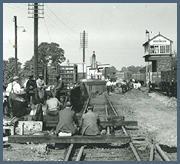
Leamington provided accommodation locomotives from the
opening of the Oxford to Birmingham line in 1852 until the shed was closed in
June 1965. The code for locomotives allocated to Leamington was 'LMTN'
during the shed's ownership by the Great Western Railway and after
nationalisation '84D' from January 1948 to August 1963 and '2L'
from September 1963 to June 1965. The first shed was located a little to the
north of the station and was single road in construction measuring 237 ft long
by 20 ft wide. It was built using timber for the framing as well as for the
side sheeting and it is recorded as being covered by a gable style slate roof.
A messroom, measuring 16 ft 0 ins by 12 ft 3 ins located to the right of the
entrance, was provided for the workforce. In 1898 two additional rooms were
built; one, measuring 13 ft 3 ins by 13 ft 8 ins, being used for stores whilst
the other, measuring 13 ft 3 ins by 6 ft 8 ins, was used as an office for the
shed foreman. Part of the shed's facilities was a coaling platform, measuring
40 ft 0 ins by 12 ft 10 ins, which was formed with stone walls and timber deck.
In 1881 a 41 ft 10 ins turntable was removed from Stafford Road shed and
installed at Leamington. On 10th March 1902 the shed burnt down which compelled
the authorities to keep the locomotives out in the open. Temporary
accommodation for the messroom, office and stores was provided by the erection
of corrugated iron huts.
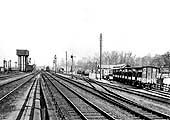
This arrangement lasted until September 1906 when the new
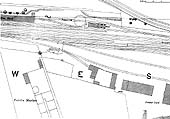
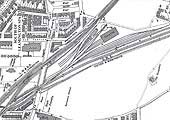
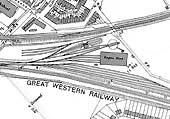
shed, situated south of the station, was opened. The shed was located between
the former LNWR's Leamington to Rugby branch line and the GWR's main line to
Banbury. Between the shed and the GWR mainline were five carriage sidings
although in reality one had to be kept free to allow the locomotive to be
released. The second shed was built to Churchward's new standard straight road
shed design and it was 180 ft long by 66 ft wide accommodating four roads.
Offices, messroom and stores were located along the northern wall for some 166
ft of its length. A separate building measuring 12 ft by 10 ft housing the sand
furnace was located on the north-west corner of the shed and was accessed via a
short siding which radiated off the turntable. In all probability the short
siding was used by wagons transporting the sand to the furnace. The western
side wall was built to allow future extension although this facility was never
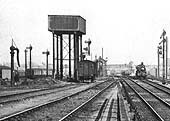
required. The 30 ft by 32 ft coaling stage was also of a new design being a
brick-built copy of the stone coal stage at Truro and included a 45,000 gallon
tank on top of the coal stage. There was a pit between the rails of all four
roads immediately in front of the shed's doors as well as one beneath the road
adjacent to the coaling stage. A turntable was provided which allowed
locomotives to be turned either after being coaled or by accessing the
turntable from one of the straight roads which lay in front of the shed.
Robert Ferris writes 'The new Leamington shed
commenced construction during 1905 and was completed before December 1906, when
an article in the in-house magazine appeared. According to the magazine the
shed was equipped with a 65 ft 'under-girder' type turntable which came into
use in July 1906. However the photographs show an 'over-girder' turntable and
65 ft 'over-girder' turntables appears to be the standard size installed from
1904 onwards (GA Drwg 16789). The 65 ft 'under-girder' types were more normal
inside round house engine sheds (e.g. Tyseley) as the 'over-girder' type were
apparently considered a hinderance to workings, but there were also external
'under-girder' types around. An 'under-girder' type required constructing of a
deeper pit, so it was more expensive. Where they were installed, the pit was
also normally 'tabled' (i.e. boarded over). In 1903 the 2-8-0 28xx class
freight locomotive had been introduced and I suspect that these as well as the
larger 4-6-0 passenger locomotives will have dictated the turntable size chosen
by Churchward for his engine shed rebuilding programme (which lasted until 1920
when Stourbridge Shed was built)'.
Use the links below to access the images and text on
this page:
Leamington's 1852 Shed
back to top
Leamington's 1906 Engine Shed
Views of the shed and its infrastructure
Leamington Shed after Closure
back to
top
The shed at work
back to
top
Staff of Leamington Engine Shed
back to
top
Locomotives on Shed
back to
top
Leamington East Junction Signal
Box
Robert Ferris writes, 'In researching this Signal Box
I noted that the Signalling Record Sociiety (SRS) stated that this was
originally called Leamington East Junction Signal Box. My information
from the GWR's name plate ordering records is that the Signal Box did change
name in circa 1913, but the name change was from Leamington South to
Leamington Spa South (see information in 'gwrls3905'). I can find no evidence that the name
'East' was ever used'.
back to top
Maps and notices
back to
top
Leamington Carriage Sidings
On 29th July 1909, the Great Western Railway Board of
Directors voted to authorise £2,715 for the laying down of new siding
accommodation for local coaching stock at Leamington, plus £300 for the
additional land required. Five carriage sidings were to be located on land
adjacent to the Locomotive Shed. Previously the local coaching stock had been
stabled in the middle station roads, but with the impending opening of the
direct route between London and Birmingham, it was proposed that these two
lines should be converted into through running lines.
The original five sidings could hold about twelve coaches
each and were all connected to a head-shunt at the far end. This head-shunt was
designed to accommodate a locomotive and one coach, so that individual coaches
could be removed from a rake if required. Carriage siding No.5 was required to
be kept clear to allow locomotives to run-round. In the late 1920’s, a
sixth dead-end siding was installed on the engine shed side of the carriage
sidings for use by Bursills. This siding was accessed from carriage siding
No.5. Details about the operational procedures for the Carriage Siding can be
found in the Appendix to the Service Timetable No.13 (dated March 1929)
gwrls3960.
In November 1942, two diesel railcars (Nos.26 & 29) were
transferred to Leamington Shed to operate the Stratford branch services. Both
moved away to Stourbridge Shed in September 1944, but returned again in August
and December 1946 respectively, with a third diesel railcar (No.33) arriving in
January 1947. About the same time the use of the sixth short dead-end siding
changed. The Appendices to the service timetable (dated April 1953 and October
1960) both state that ‘No.6 Siding is a dead-end siding for the
stabling of spare coaching stock.’ In July 1959 the carriage sidings
were altered to provide diesel fuelling facilities for the local DMU sets,
which were being allocated there, but on 19th July 1966 the sidings were
closed.
Robert Ferris
back to
top
Locomotive Allocation for original Leamington Shed in 1901
(12 locomotives)
| Wheel arrangement
|
Class |
Number |
| 0-4-2T |
517 |
837, 1427, 1429, 1432, 1475 |
| 0-6-0ST |
655 |
1780 |
| 2-4-0 |
439 |
20 |
| 0-6-0 |
388 (Armstrong Standard Goods) |
32, 390, 711 |
| 0-6-0 |
322 (Beyer Goods) |
325 |
| 0-6-0 |
2301 (Dean Goods) |
2425 |
Locomotive Allocation for Leamington Shed (LMTN) in 1906
(13 locomotives)
| Wheel arrangement
|
Class |
Number |
| 2-4-2T |
36xx |
3606, 3623, 3627, 3628, 3629 |
| 0-6-0ST |
645 |
766 |
| 2-4-0 |
481 |
490 |
| 0-6-0 |
388 (Armstrong Standard Goods) |
38, 402, 421, 890 |
| 0-6-0 |
322 (Beyer Goods) |
326 |
| 0-6-0 |
2301 (Dean Goods) |
2555 |
Locomotive Allocation for Leamington Shed (LMTN) in 1920
(25 locomotives)
| Wheel arrangement
|
Class |
Number |
| 2-4-0T |
Metro Tank |
467, 1413, 1419 |
| 2-4-2T |
36xx |
3604, 3616, 3620, 3623, 3630 |
| 0-6-0ST |
645/1501 |
1506, 1805 |
| 0-6-0ST |
655 |
2716 |
| 2-6-2T |
39xx (Rebuilds from Dean Goods) |
3903, 3918, 3919 |
| 0-6-0 |
388 (Armstrong Standard Goods) |
405, 673, 689 |
| 0-6-0 |
322 (Beyer Goods) |
340 |
| 0-6-0 |
2301 (Dean Goods) |
2406 |
| 2-8-0 |
30xx (Ex R.O.D.) |
3001, 3022, 3023 |
| 4-4-0 |
32xx (Duke) |
3264 ‘Trevithick’, 3285
‘Katerfelto’ |
Locomotive Allocation for Leamington Shed (LMTN) in 1930
(26 locomotives)
| Wheel arrangement
|
Class |
Number |
| 0-4-2T |
517 |
1478, 1483 |
| 2-4-2T |
36xx |
3621, 3623 |
| 0-6-0PT |
1076 (Buffalo) |
1260, 1276 |
| 0-6-0PT |
645/1501 |
1542 |
| 0-6-2T |
56xx |
6695, 6696, 6697, 6699 |
| 2-6-2T |
51xx |
5113, 5116, 5118, 5121, 5134, 5139, 5140 |
| 0-6-0 |
322 (Beyer Goods) |
354 |
| 0-6-0 |
2301 (Dean Goods) |
2356 |
| 2-6-0 |
26xx (Aberdare) |
2633, 2656 |
| 4-4-0 |
38xx (County) |
3809 ‘County Wexford’, 3815 ‘County of
Hants’, 3834 ‘County of Somerset’, 3836 ‘County of
Warwick’ |
Locomotive Allocation for Leamington Shed (LMTN) in 1938
(31 locomotives)
| Wheel arrangement
|
Class |
Number |
| 0-4-2T |
48xx |
4801, 4814 |
| 0-6-0PT |
655 |
1773 |
| 0-6-0PT |
57xx |
5700, 7702, 9742 |
| 0-6-2T |
56xx |
6602, 6665, 6696, 6697 |
| 2-6-2T |
51xx |
4112, 4121, 4122, 4126, 5119, 5128, 5134, 5136, 5138,
5155, 5163, 5171, 5174, 5175, 5181, 5192 |
| 2-6-2T |
3150 |
3163 |
| 0-6-0 |
2301 (Dean Goods) |
2436 |
| 2-8-0 |
28xx |
3802 |
| 4-6-0 |
29xx (Saint) |
2914 ‘Saint Augustine’, 2924 ‘Saint
Helena’ |
Locomotive Allocation for Leamington Shed (84D) in 1948 (30
locomotives + 2 Railcars)
| Wheel arrangement
|
Class |
Number |
| 0-6-0PT |
57xx |
2772, 3631, 7702, 9740 |
| 0-6-2T |
56xx |
5634, 6625, 6632, 6644, 6650, 6657, 6697 |
| 2-6-2T |
51xx |
4102, 4112, 5104, 5109. 5130, 5144, 5161, 5163, 5185,
5187, 5192, 5194 |
| 2-6-2T |
81xx |
8100, 8109 |
| 2-8-2T |
72xx |
7218 |
| 4-6-0 |
29xx (Saint) |
2902 ‘Lady of the Lake’, 2933 ‘Bibury
Court’ |
| 4-6-0 |
49xx (Hall) |
4934 ‘Hindlip Hall’ |
| 4-6-0 |
78xx (Manor) |
7810 ‘Draycott Manor’ |
| |
Diesel Railcars |
26, 29 |
Locomotive Allocation for Leamington Shed (84D) in 1959 (20
locomotives)
| Wheel arrangement |
Class |
Number |
| 0-6-0PT |
57xx |
3619, 3624, 3631, 7702 |
| 0-6-2T |
56xx |
6657, 6697 |
| 2-6-2T |
51xx |
4103, 4112, 4118, 4162, 4171, 5101, 5184 |
| 2-6-2T |
81xx |
8100, 8109 |
| 2-6-2T |
Class 2 |
41227, 41228, 41285 |
| 2-6-4T |
Class 4 |
42566 |
| 2-8-0 |
Ex War Dept |
90483 |
Locomotive Allocation for Leamington Shed (84D) in 1965 (13
locomotives)
| Wheel Arrangement |
Class |
Locomotive Running Number |
| 0-6-2T |
56xx |
6644, 6671 and 6697 |
| 2-6-0 |
2MT |
46428, 46442, 46457, 46470 and 46505 |
| 4-6-0 |
5MT |
73026, 73066, 73069 and 73156 |
| 2-6-4T |
4MT |
80072 |
Recording Locomotive Sightings 1943 - 1968
The following information is provided courtesy of Shed Bash
UK (http://shedbashuk.blogspot.co.uk/)
A generation of enthusiasts recorded the movements of
locomotives around the railway system. These records of visits to locomotive
depots have been collected and carefully analysed to provide an overall
portrait for the period 1943 to 1968. During that period of steam's final
years, there was a marked change from the pre-grouping types that still found
work at a few depots, to the modern BR designs that worked until the end in
1968. The handling of freight and passenger services was a major undertaking
from town and cities, ports, coal mines and factories. All of it traversed the
labyrinth of lines that criss-crossed the country. There were numerous 'sheds'
spread throughout the length and breadth of the land that provided and serviced
the vast army of steam locomotives (20,000 in 1948). Here is just a taste of
that history.
|


 Donate
 Facebook
 Search